

Incentives
Incentives
Dayton Incentives & Grants
Business Assistance Grant Programs
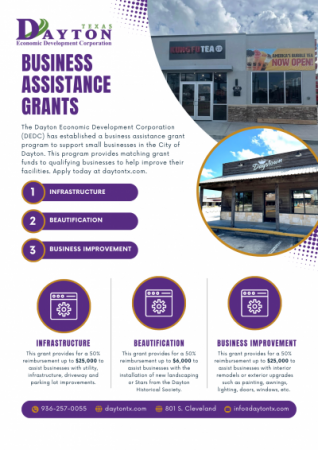
Businesses located within the City of Dayton, Texas are encouraged to apply for grants from the Dayton Economic Development Corporation (DEDC) for the following programs:
- Business Improvement Grant ($25,000 maximum award)
- Beautification Grant ($6,000 maximum award)
- Infrastructure Grant ($25,000 maximum award)
All grants funds are provided on a 50% reimbursement basis.
Large Incentive Grant Program
Businesses that meet a minimum capital investment of $500,000 may be eligible for incentives from the City of Dayton or the Dayton Economic Development Corporation. Incentives may include:
- Cash Grants
- Sales Tax Rebates
- Rebated Permitting Fees
- Rebated Impact Fees
In order to qualify for any of these incentives, businesses must complete an application and submit it for review to the Director of Economic Development. Each business is evaluated based on the capital investment made, number of jobs created and sales or property tax generated. The total amount of incentives is negotiated by the applicant and the City of Dayton and/or Dayton EDC. All incentive agreements require approval from the Dayton City Council and/or the Dayton EDC Board of Directors.
Property Tax & Tax Abatements
The City of Dayton offers a property tax abatement program in accordance with Chapter 312 of the Texas Tax Code. tax abatement is a local agreement between a taxpayer and a local taxing unit that exempts all or part of the increase in the value of property from taxation for a period not to exceed 10 years. Tax abatements are an economic development tool available to cities, counties and special districts to attract new industries and to encourage the retention and development of existing businesses through property tax exemptions or reductions.
Property Tax Abatement Act (Chapter 312)
Chapter 380 Agreements
Chapter 380 of the Local Government Code authorizes municipalities to offer a range of incentives, designed to promote state or local economic development. Specifically, it authorizes the city to provide loans and grants of city funds or services at little or no cost to encourage state and local economic development.
Local Government Code Chapter 380
Supporting Documents
State Incentive Resources
For more detailed information about the programs listed below, please visit the State of Texas Economic Development Office's website.
State Sales & Use Tax Exemptions
Manufacturing Machinery & Equipment: Leased or purchased machinery, equipment, replacement parts, and accessories that are used or consumed in the manufacturing, processing, fabricating, or repairing of tangible personal property for ultimate sale, are exempt from state and local sales and use tax. Texas businesses are exempt from paying state sales and use tax on the purchase of machinery exclusively used in processing, packing, or marketing agricultural products by the original producer at a location operated by the original producer. Texas businesses are also exempt from paying state sales and use tax on labor for constructing new facilities.
Natural Gas & Electricity: Texas companies are exempt from paying state and local sales and use tax on electricity and natural gas used in manufacturing, processing, or fabricating tangible personal property. The company must complete a “predominant use study” that shows at least 50 percent of electricity or natural gas consumed by the business directly causes a physical change to a product.
Renewable Energy Incentive
Texas property tax code permits a 100 percent exemption on the appraised value of solar, wind, or biomass energy devices installed or constructed for the production and use of energy on-site.
Pollution Control Equipment Incentive
A Texas constitutional amendment providing an exemption from property taxation for pollution control was approved in 1993. The intent was to ensure that compliance with environmental mandates, through capital investments, did not result in an increase in a facility’s property tax. A facility must first receive a determination from the Texas Commission on Environment Quality (TCEQ) that property is for pollution control purposes. That positive use determination is then provided to the local appraisal district, property an exemption from property taxes.
Skills Development Fund
The Skills Development Fund is an innovative program created to assist Texas public community and technical colleges finance customized job training for their local businesses. The Fund is administered by the Texas Workforce Commission. Grants are provided to help companies form partnerships with local community colleges and technical schools to provide custom job training. Average training costs are $1,800 per trainee; however, the benefit may vary depending on the proposal.
Economic Development & Diversification In-State Tuition for Employees
Economic Development & Diversification In-State Tuition for Employees is a program that allows employees—and those employees’ family members—of a qualified business considering a relocation or expansion of its operations in the State of Texas to pay in-state tuition rates at public institutions of higher education in the state without first establishing residency.
A city, county or economic development group covering the Texas region in which the qualified business is considering locating, may apply on behalf of the business, so long as the business is still in the decision-making process to relocate or expand its operations at the applicable site.
Texas Enterprise Zone Program
An enterprise project is eligible for a refund for all state sales and use taxes paid and used at the qualified business site. The total amount of any refund will continue to be predicated on the investment amount and number of jobs created/retained.
Assuming the project investment amount is equal to or greater than $600 million and the company will create the projected 340 qualified jobs they could receive a refund of $2,500 per job. The maximum refund available is $1.25 million over a 5-year project designation period. Receipts for purchases of building materials and machinery and equipment and payroll information are required to be retained as part of the audit process.
TCEQ Permit Expediting
Title 30 Texas Administrative Code (TAC) Chapter 101, Subchapter J allows an applicant to request the expedited processing of an application filed under 30 TAC Chapters 106, 116, or 122 if the applicant demonstrates that the purpose of the application will benefit the economy of this state or an area of this state. The Texas Commission on Environmental Quality (TCEQ) may expedite these applications, subject to the availability of commission resources for expediting permit applications. To request expedited processing of an application, the applicant must submit an Expedited Permitting Request Form (Form APD-EXP), the Air Permitting Surcharge Payment Form (Form APD-APS), and the surcharge fee payment.
Additionally, the Governor’s Office works closely with new and expanding companies offering a point of contact with TCEQ. The ombudsman will assist with coordination of pre-permit planning discussions with the designated environmental authority responsible for the company’s environmental activities.
Texas Enterprise Fund
The Texas Enterprise Fund (TEF) awards “deal-closing” grants to companies considering a new project for which one Texas community is competing with other out-of-state sites. The fund serves as a financial incentive for those companies whose projects would contribute significant capital investment and new employment opportunities to the state’s economy.
The performance-based cash grants are calculated according to a uniform analytical model for each applicant. Award amounts are calculated on the average wage of new employees, taking into account the expected hiring timeline and number of jobs created, with per-job award amounts subject to adjustment based on the company’s total proposed capital investment.
To be eligible to apply for TEF, applicants must meet the following criteria:
- The single Texas community being considered for the project must be in active competition with at least one out-of-state site, and the company must not have made a location decision. Actions signifying the company has already made a location decision include, but are not limited to—signing a lease, purchasing land, hiring employees and/or making a location announcement.
- Projected new job creation must exceed 75 full-time jobs (urban areas) or 25 full-time jobs (rural areas).
- The total average wage for new jobs must meet or exceed the average county wage for the county in which the project would be located during the full term of the grant agreement.
- The company must demonstrate significant levels of planned capital investment.
- The project must be supported by the city, county and/or economic development corporation in which the project would be located, particularly in the form of local economic incentive offers.
- The company must be well-established and financially sound.
- The company must operate in an advanced industry that affords it other feasible location options nationally and/or internationally.
With a rolling application period, eligible companies must submit a complete application packet to be considered for a TEF grant. TEF applicants undergo a thorough due diligence screening process. Areas of focus include project competitiveness, corporate activity, financial standing, tax status, legal issues, credit ratings, estimated economic impact, and the business climates of competing locations. The Governor, Lieutenant Governor, and Speaker of the House review all applications and must unanimously agree to support the use of TEF for each applicant.
If approved for a TEF grant and upon acceptance of such a grant, all TEF awardees must sign a grant contract with the state which legally obligates the company to fulfill, among other things, projected job creation and average wage commitments. No TEF funds are disbursed until after grantees sign a grant contact and meet their respective job and wage targets for each individual period (typically annually). Grantees are required to maintain these jobs and wage figures throughout the term of the contract. In the event a grantee fails to do so or fails to meet other terms of the grant contract, certain contract provisions allow the Governor’s Office to demand repayment of previously disbursed grant funds in the form of clawbacks. Each TEF grantee will also participate in a press release with the Governor’s Office announcing the project and the TEF award amount.
Supporting Documents
Timeline for Local Incentives - Dayton, Texas